Know When a Consumer Problem May Be Legal: You Paid. They Promised. Something Went Wrong. Now What?
Thomas D. White, Senior Partner, EQUES Law Group
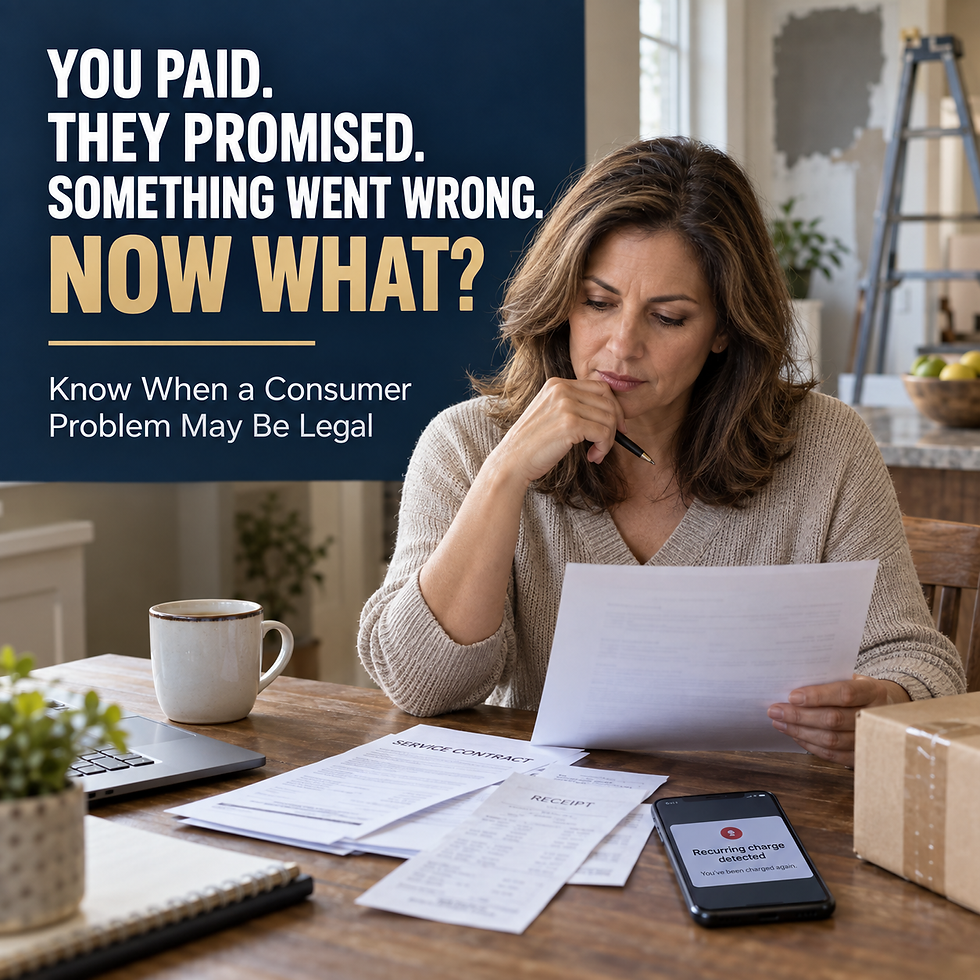
You paid for a product or service. The business made promises. Then something went wrong.
Maybe the product never arrived. The contractor abandoned the job. The “free trial” became a recurring charge. Or the company advertised one thing, delivered another, and now refuses to make it right.
Is it merely bad customer service—or could it be a deceptive practice or another legal issue?
The distinction matters. Poor communication may justify a complaint or negative review. But broken contractual promises, misleading claims, unauthorized charges, and ignored warranties can implicate consumer-protection laws.
Bad Service Is Frustrating—but Not Always Unlawful
Long hold times, rude employees, delayed responses, and inflexible policies may be signs of a poorly run business. Standing alone, however, they do not necessarily establish a legal claim.
A problem is more likely to cross into legal territory when the business:
Made a specific promise and failed to honor it
Misrepresented an important fact about the product, service, price, or refund policy
Left out information that would have affected your decision to buy
Charged more than you authorized
Continued billing after cancellation
Failed to deliver what you purchased
Refused to honor an applicable warranty
Used similar tactics against multiple consumers
A broken promise may support a breach-of-contract or warranty claim even if it was not deceptive. Conversely, a misleading sales practice may violate consumer-protection law even when the paperwork is carefully worded.
When Does a Practice Become “Deceptive”?
The Federal Trade Commission generally considers a practice deceptive when it involves a statement, omission, or practice that is likely to mislead a reasonable consumer—and the information is important to the consumer’s decision. In other words, ask:
What did the business represent?
Was that representation false, incomplete, or misleading?
Would the truth likely have changed your decision to pay?
Suppose a company advertises a service for $99 but reveals a mandatory $150 fee only after the work begins. Or a seller claims a product can perform a particular function when it cannot. Those facts may point to something more serious than careless service.
Federal law prohibits unfair or deceptive acts or practices, and states have their own consumer-protection statutes. The available remedies and legal standards vary by jurisdiction. The FTC’s deception policy explains the federal framework.
Watch for These Warning Signs
The promise was specific
“Best service in town” is usually sales talk. “Delivery by Friday,” “cancel anytime,” or “full refund within 30 days” is much more concrete.
Save advertisements, estimates, contracts, emails, text messages, receipts, and screenshots showing exactly what was promised.
The business changes its story
Be cautious if the explanation shifts whenever you ask for a refund or correction. Conflicting statements do not automatically prove deception, but they can be important evidence.
Important terms were hidden
Unexpected mandatory fees, undisclosed renewal terms, or limitations buried where a consumer would be unlikely to notice may raise concerns—especially when the missing information affected the purchase.
The company will not honor its warranty
Written warranties matter, but implied warranties may also apply under state law. For example, an implied warranty may generally mean that a product should perform its ordinary function. Coverage varies, and some states permit properly disclosed “as is” sales.
The FTC’s warranty guide provides an overview.
Other consumers describe the same conduct
A pattern of nearly identical complaints can suggest that the problem is not an isolated mistake. Keep in mind that reviews are clues, not proof.
What Should You Do Next?
1. Preserve the evidence
Create a simple file containing:
The advertisement or product listing
Your contract, estimate, invoice, and receipt
The warranty and return policy
Photographs or video of the problem
Emails, texts, chat transcripts, and cancellation confirmations
A timeline of calls, names, dates, and promises
Bank or card statements showing the charge
Save webpages and screenshots promptly. Online terms and advertisements can change.
2. Tell the business exactly what you want
Contact the business in writing. Briefly explain what you bought, what was promised, what happened, and how you want the problem resolved.
Request a specific outcome—such as a refund, repair, replacement, cancellation, or completion of the work—and provide a reasonable deadline. Keep your message factual and save proof that it was sent. The FTC offers a sample consumer complaint letter.
3. Do not miss a payment-dispute deadline
If you paid by credit card, contact the issuer promptly. For certain billing errors, federal protections generally require a written dispute to reach the card issuer within 60 days after the first statement containing the error was sent. Calling or submitting an online dispute may not substitute for the required written notice.
Different rules may apply to product-quality disputes, debit cards, payment apps, checks, and other payment methods. Review the CFPB’s credit-card dispute guidance and act quickly.
4. Escalate the complaint
Depending on the problem, you may consider contacting:
Your state attorney general or consumer-protection office
The agency that licenses the business or professional
The Consumer Financial Protection Bureau for covered financial products
The Federal Trade Commission through ReportFraud.ftc.gov
A dispute-resolution or arbitration program
Your local small-claims court
The FTC generally does not resolve individual complaints, but reports can help authorities detect patterns and investigate unlawful conduct. USAGov maintains a directory of state consumer-protection offices.
5. Speak with a consumer attorney when the stakes are significant
Consider getting legal advice if the amount is substantial, the business threatens collections, the conduct caused safety or property damage, multiple consumers appear affected, or an approaching deadline may limit your options.
A lawyer can evaluate possible claims involving contracts, warranties, fraud, unfair or deceptive practices, debt collection, or other state and federal laws.
The Bottom Line
Not every terrible customer experience is illegal. But “customer service” should not become a shield for false promises, hidden terms, unauthorized charges, or the refusal to provide what a consumer purchased.
Document the promise. Identify what went wrong. Ask for a specific solution. Protect any dispute deadlines. And when the facts suggest more than an ordinary mistake, consider reporting the conduct or obtaining legal advice.
This article provides general information about U.S. consumer issues and is not legal advice. Laws, deadlines, and available remedies vary by state and circumstance.


This is a useful reminder that keeping receipts, contracts, and written communication can make a big difference when a purchase goes wrong. Knowing your consumer rights is always worth it. After sorting out these issues, I like taking a short break with Golf Hit to relax!