What Are Your Rights When a Business Treats You Unfairly in Indiana?
- 4 minutes ago
- 3 min read
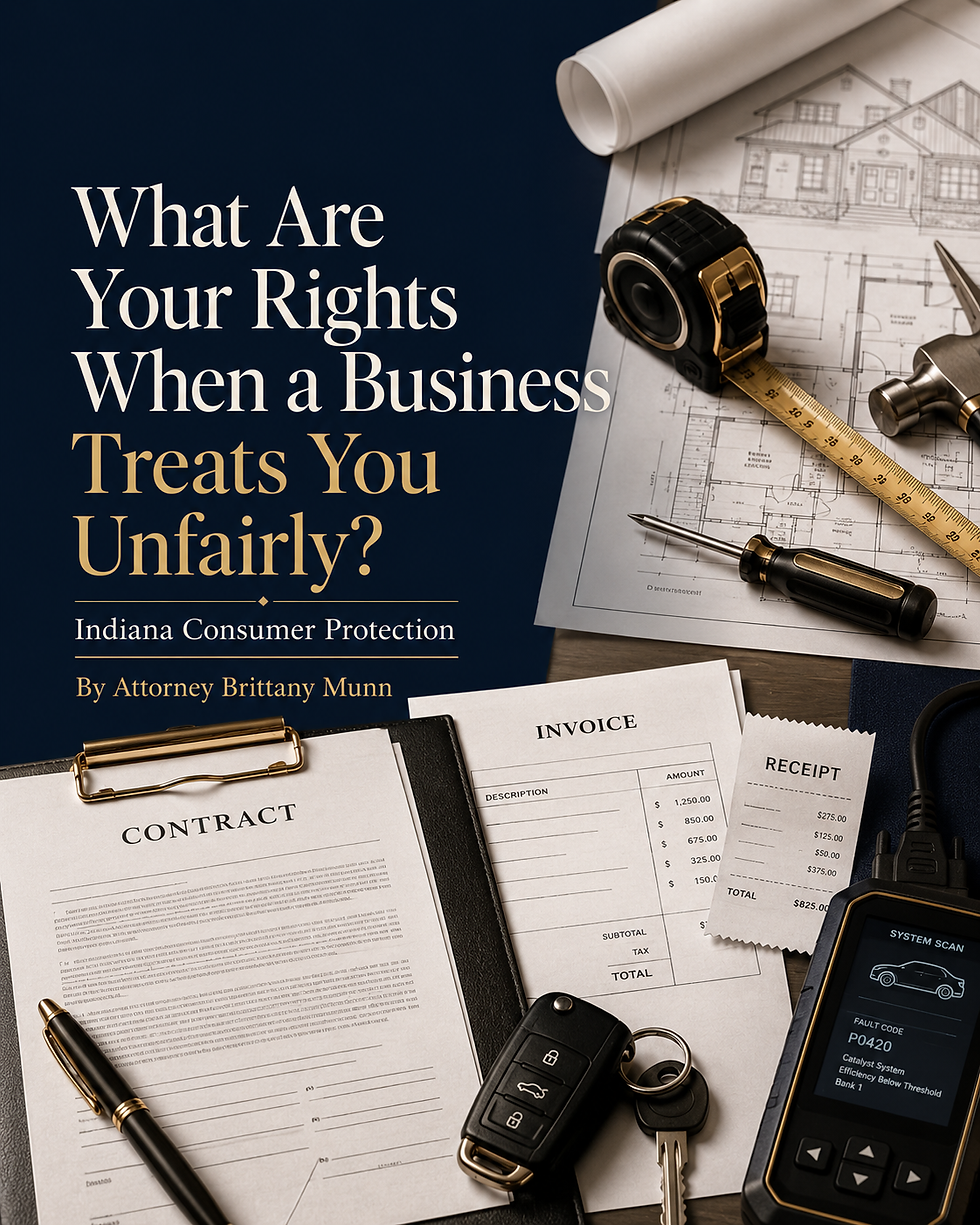
Most of us have been there. Buying a vehicle, hiring a contractor to remodel your home, or paying for major repairs often requires a significant financial investment. Most consumers enter these transactions expecting honesty, quality work, and fair treatment.
Unfortunately, that does not always happen.
A contractor may stop showing up halfway through your home renovation. A dealership may misrepresent the condition of a used vehicle. An auto repair shop may charge you for repairs that never fix the problem or even make it worse. When these situations arise, it can be difficult to know whether you are dealing with poor customer service or a potential legal issue.
Understanding your rights as a consumer is an important step in protecting yourself and your investment.
Depending on the circumstances, businesses that engage in unfair or deceptive practices may expose themselves to legal liability. Examples may include:
· Making false or misleading statements about a product or service before you
agree to purchase it;
· Advertising a used vehicle in a condition that is materially different from its
agree to purchase it;
· Representing that repairs are necessary when they are not, or charging for
work that was never performed;
· Promising a home renovation or construction project will include specific
materials, finishes, or features that are never actually provided;
· Accepting payment while repeatedly failing to perform the agreed-upon work;
· Making promises about warranties or guarantees that the business later refuses
to honor;
· Adding unexpected charges or fees that were never disclosed before the
agreement.
Whether a business has crossed the lines depends on the facts of each situation. Consumers should not assume they have no options simply because a business tells them “there is nothing we can do.”
Common Consumer Issues in Construction and Home Improvement
Construction and remodeling projects often involve substantial investments, making disputes especially stressful for homeowners.
Some of the most common concerns include:
· Contractors who fail to complete the project;
· Work that is significantly defective or not performed in a workmanlike manner;
· Unexpected change orders or additional charges;
· Misrepresentations about licensing, experience, or qualifications;
· Poor communication after receiving payment; and
· Delays that were never disclosed or reasonably explained.
While every project encounters challenges, consumers deserve transparency and honest communication throughout the process.
Vehicle Purchases and Auto Repair Disputes
Vehicle purchases are often one of the largest financial decisions consumers make. Problems may arise when:
· A dealership misrepresents the condition or history of a vehicle;
· Important defects are concealed or inaccurately described;
· Warranty coverage is promised but later denied;
· Financing or pricing terms differ from what was represented;
· An auto repair facility performs unauthorized repairs;
· Consumers are billed for work that was never completed; and
· The same mechanical problem continues despite repeated repair attempts.
If something does not seem right, do not assume your concerns are simply “part of buying a used car.” Asking questions early can help you better understand your rights and available options.
Protect Yourself by Preserving Documentation
One of the most important things consumers can do is keep thorough records. If a dispute develops, documentation often becomes one of the strongest forms of evidence available.
Depending on the situation, consider preserving:
· Contracts and written agreements;
· Estimates and invoices;
· Receipts and proof of payment;
· Emails and text messages;
· Photographs and videos documenting the condition of the work, property, or
vehicle;
· Advertisements, website listings, or marketing materials;
· Warranty documents;
· Repair estimates and inspection reports;
· Notes documenting conversations, including dates, times, and the names of
individuals involved.
Many disputes are won or lost based on documentation rather than memory.
When Should You Contact an Attorney?
Not every dispute requires litigation, and many consumer matters can be resolved without filing a lawsuit.
However, it is worthwhile to seek legal advice and discuss your options if:
· A contractor abandons your project or refuses to correct defective work;
· You believe a business made false or misleading representations before you
entered into an agreement;
· A dealership or repair shop refuses to address significant issues despite
repeated requests;
· A business fails to honor a warranty or written contract;
· You are being asked to sign a settlement agreement or release; or
· The financial loss is substantial, or you simply are not sure what your legal
rights are.
We can evaluate your situation, explain the applicable law, and help you determine the most practical path forward based on your specific circumstances. Contact EQUES Law Group to learn how we can help you.



Comments