Still Arguing About the Driveway? A Year-End Plan for Unresolved Property Disputes
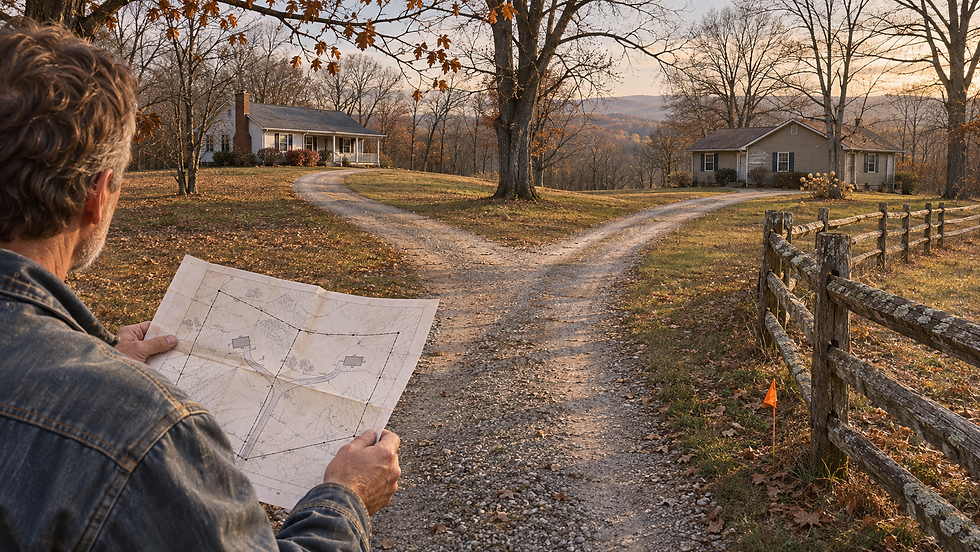
By: Thomas White, Esq Before another construction season begins, Ohio property owners should take practical steps to resolve disagreements over driveways, easements, access roads, and property boundaries.
The fence is still in the wrong place. Your neighbor continues parking in the shared driveway. Someone has threatened to block the access road you have used for decades. Or perhaps a disagreement over a few feet of land has turned into a much larger dispute.
Property disagreements have a way of lingering. What begins as a question about a boundary line or driveway can develop into years of frustration, strained relationships, and significant legal expense.
As 2026 draws to a close, property owners have an opportunity to evaluate unresolved disputes and develop a plan before spring construction, landscaping, farming, and improvement projects begin.
The goal should not simply be to win an argument with a neighbor. It should be to establish clear, enforceable property rights and prevent the same disagreement from resurfacing year after year.
1. Identify What the Disagreement Is Really About
Not every disagreement involving a driveway is a boundary dispute. Different legal issues require different solutions.
Boundary disputes concern where one parcel ends and another begins. An existing fence, driveway, or landscaping feature may not coincide with the legal boundary. This is especially true in rural areas where there has not been a modern survey and plat (surveyor’s drawing) of the property.
Easement disputes involve the right to use another person's property for a particular purpose, such as accessing a home, farm, or commercial building. An easement may exist even though the person using the driveway does not own the underlying land.
Shared-driveway disputes frequently concern how an established access route may be used. Neighbors may disagree about parking, maintenance costs, snow removal, drainage, gates, or whether the driveway can accommodate additional traffic.
Access disputes may arise when one owner claims the right to cross another owner's property, particularly when a parcel has limited access to a public road.
Before deciding what action to take, identify precisely what each party claims and what conduct is causing the problem.
For example, if both neighbors acknowledge that a driveway easement exists, the dispute may concern its permitted use rather than its existence. That distinction can substantially narrow the issues and make settlement more achievable.
2. Understand That Longstanding Use Does Not Always Establish Ownership
One of the most common assumptions in property disputes is that using land for many years automatically creates a permanent legal right.
Ohio law is more complicated.
An easement may arise through a written grant, prescription, implication, or necessity, depending on the facts and applicable legal requirements.
A prescriptive easement generally requires clear and convincing evidence of open, notorious, adverse, and continuous use for at least 21 years. Longstanding use alone does not necessarily satisfy those requirements. The circumstances under which the use began, including whether it was permissive, may be important.
Property owners should also distinguish an easement from adverse possession. An easement permits certain uses of another person's land, while adverse possession can result in acquisition of ownership when its demanding requirements are established.
In April 2026, the Supreme Court of Ohio emphasized the strict requirements for adverse possession in NC Ents., L.L.C. v. Norfolk & W. Ry. Co., 2026-Ohio-1429. The Court concluded that the landscaping activities at issue were insufficient to establish the required open and notorious possession for 21 years.
The lesson is that neither a longstanding practice nor an owner's personal understanding of a boundary necessarily determines the legal rights of the parties.
3. Organize Your Evidence Before Memories Fade
Property litigation often depends on documents, photographs, historical use, and witness testimony.
Rather than relying on recollections of conversations with neighbors, property owners should assemble a single organized file containing:
1. Deeds and recorded documents. Obtain the current deeds, relevant prior deeds, recorded easements, plats, and agreements affecting the properties.
2. Surveys and maps. Gather existing surveys and consider whether a new survey by an Ohio professional surveyor is necessary. County GIS maps can be helpful starting points but should not be treated as definitive boundary surveys.
3. Photographs and videos. Preserve dated images showing the driveway, fences, gates, drainage conditions, improvements, and any interference with access. Older photographs and aerial imagery may be particularly valuable.
4. Maintenance and construction records. Collect receipts for gravel, paving, grading, culverts, snow removal, and other work. These documents may help establish how the property has been used and maintained.
5. Communications and witness information. Save relevant letters, emails, text messages, and notes of conversations. Identify former owners or longtime neighbors who may have firsthand knowledge of historical use.
6. A written chronology. Prepare a timeline identifying when the driveway was constructed, how it has been used, when the disagreement began, and what each party has done since.
Evidence should be preserved in its original form whenever possible.
A survey is often an essential starting point, but it may not resolve every legal issue. A properly established easement or another legally recognized property interest can sometimes affect how land may be used even when its surveyed ownership boundary is not disputed.
4. Evaluate Negotiation Before Filing a Lawsuit
Not every property dispute requires litigation.
Sometimes the most practical solution is a written agreement addressing the specific issues that caused the disagreement.
For example, neighbors sharing a driveway might agree on its location and width, who may use it, whether parking is permitted, how maintenance expenses will be divided, and who will be responsible for snow removal and drainage improvements.
Other negotiated solutions may include relocating a driveway, granting or exchanging easements, establishing a mutually accepted boundary, or purchasing a disputed strip of land.
When a permanent property right is being created or clarified, the agreement should be drafted with an appropriate legal description, properly executed, and recorded when required or appropriate to protect the parties and future owners.
Mediation may also provide a useful alternative. An experienced neutral mediator can help parties develop practical arrangements that may be more flexible than relief available after a contested trial.
A successful settlement should do more than resolve the present disagreement. It should establish workable rules that reduce the possibility of future conflict.
5. Know When Litigation May Be Necessary
Negotiation is not always successful.
Litigation may be appropriate when a neighbor refuses to recognize a legally established easement, blocks the only practical access to a property, constructs improvements across a disputed boundary, or otherwise substantially interferes with property rights.
Depending on the circumstances, Ohio property owners may have several legal remedies.
A declaratory judgment action may allow a court to determine the parties' rights under a deed or other written instrument.
An action to quiet title may be appropriate to resolve competing claims to interests in real property when the statutory requirements are satisfied.
An injunction may be available to prevent or remedy unlawful interference with property rights. When immediate harm is threatened, your attorney should evaluate whether temporary injunctive relief is justified.
Trespass claims or other remedies may also be available, depending on the evidence.
Litigation, however, carries costs and uncertainties. Surveys, title examinations, expert witnesses, discovery, depositions, and court proceedings can become expensive.
Before filing suit, property owners should evaluate the strength of their legal position, the evidence needed to prove it, the actual harm involved, and whether the likely result justifies the expense.
A lawyer can also identify applicable filing deadlines and determine whether delay could prejudice a claim. There is no general rule that all property disputes can safely wait until spring.
6. Develop a Year-End Action Plan
If a property dispute remains unresolved, the final months of 2026 offer an opportunity to prepare for the coming year.
November: Gather the facts. Obtain deeds, surveys, photographs, correspondence, and maintenance records. Develop a chronology and identify disputed facts.
December: Evaluate your rights. Consult legal counsel to review the relevant documents and determine whether a valid boundary, easement, access, or ownership claim exists.
January: Explore resolution. Consider a written settlement proposal, a meeting between counsel, or mediation. If an agreement is reached, make sure the documents adequately protect the property rights involved.
February and March: Prepare for spring. If negotiations fail, determine whether litigation is appropriate before proposed fencing, grading, paving, construction, or other improvements make the dispute more difficult or expensive to resolve.
This schedule is a planning tool, not a reason to postpone action. Threatened obstruction, imminent construction, or other urgent circumstances may require immediate legal attention.
Property owners should also avoid escalating a dispute by unilaterally removing a fence, placing barriers across a driveway, relocating survey monuments, or interfering with a neighbor's access without first obtaining legal advice.
A Better Goal: Certainty Instead of Continuing Conflict
Property disputes are often highly personal. A driveway may have been used by several generations of a family. A fence may have stood in the same location for decades. A disagreement involving only a small portion of land may affect access, property value, future construction, or the ability to sell the property.
Nevertheless, allowing these disagreements to continue indefinitely rarely makes them easier to resolve.
The most effective approach begins with understanding the legal rights involved, preserving the evidence, defining the actual disagreement, and evaluating realistic solutions.
Whether the answer is a recorded easement agreement, a negotiated boundary adjustment, mediation, or court intervention, the objective should be the same: a clear and lasting resolution.


Comments